
Root Canal Treatment
A root canal treatment can save a badly infected or damaged tooth. The tooth may have become infected or damaged by decay, repeated dental work, wear and tear,cracked fillings or an injury to the tooth. When the dental pulp is damaged, bacteria can start to multiply inside the tooth. This can lead to an infection or abscess, which is a pocket of pus that forms at the end of the tooth’s root.
Saving your own tooth if possible is important. It works better than an artificial tooth for biting and chewing. Losing a tooth can lead to other problems in the mouth. Replacing a lost tooth with an artificial one often needs more complex dental procedures. Root canal treatment is often the best way of saving a tooth.
What are the signs I might need a root canal treatment?
Sometimes there are no symptoms that a tooth needs root canal treatment. More commonly, the signs include:
- Severe toothache when biting or chewing
- Sensitivity to hot or cold that lasts after the heat or cold has been removed
- Darkening of the tooth
- Swollen and tender gums
- Pus around an infected tooth
- Swelling of the face or neck
- A loose tooth
What happens during a root canal treatment?
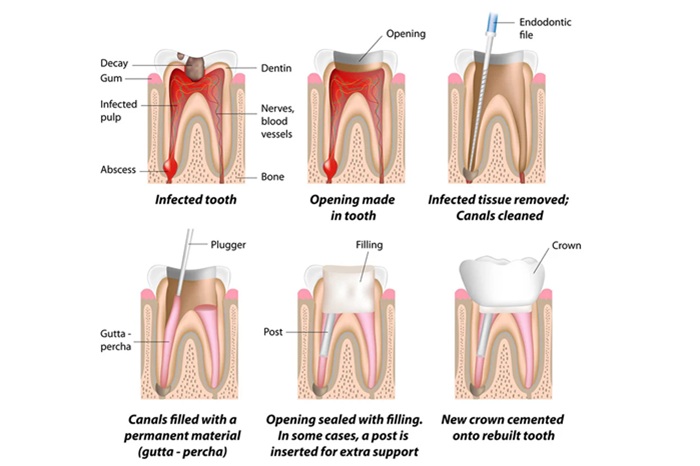
First, the dentist takes an x-ray of the tooth to see the shape of the root canals and determine whether there is any infection in the bone around the tooth. A sheet or rubber called a rubber dam is placed over the tooth to prevent contamination. You will be able to breathe normally. The dentist will use a local anaesthetic to numb the area around the tooth before drilling a hole in the tooth to remove the pulp. Each tooth has between 1 and 4 canals, depending on the tooth. All of the canals will be cleaned, shaped and disinfected.
It can take several appointments, often 2-3, for the dentist to clean and shape the hole inside the tooth before placing a sterile filling inside. Between treatments they will seal the tooth with a temporary filling and may place a metal band around the tooth to protect it. When the treatment is finished, they will fill the canal space with a material called gutta percha.
Often a crown on the tooth is recommended after to protect the tooth as the tooth will never be as strong as the original. Root canal treatments nowadays are extremely effective and should be almost completely pain free because of the anaesthetic. There may be some pain and gum swelling once the effects of the anaesthetic wears off, and a dose of ibuprofen is an ideal root canal pain treatment.
Frequently Asked Questions
What is root canal treatment?
Root canal treatment saves a tooth that is badly infected or damaged. The dentist removes the damaged or infected pulp inside the tooth, cleans and disinfects the canals, and fills them to seal the tooth. Saving your natural tooth is usually better than losing it, because it works better for biting and chewing than an artificial one.
What are the signs I might need a root canal?
Common signs include severe pain when biting or chewing, sensitivity to hot or cold that lingers, a darkened tooth, swollen and tender gums, pus around the tooth, swelling in the face or neck, and a loose tooth. Sometimes there are no symptoms at all, which is why regular check-ups matter.
Is root canal treatment painful?
No. We numb the area with a local anaesthetic, so the procedure should be almost completely pain-free. Some soreness is normal once the anaesthetic wears off.
What happens during a root canal treatment?
We take an X-ray to check the shape of the root canals and any infection in the bone. We then isolate the tooth with a rubber dam, numb the area, remove the damaged pulp, and clean, shape and disinfect each canal. Each tooth has 1 to 4 canals. The canals are then filled and sealed.
How many appointments will I need?
Often 2 to 3 appointments. Between visits, the tooth is sealed with a temporary filling and may have a metal band placed around it for protection.
Will I need a crown after a root canal?
A crown is often recommended, because a treated tooth is never as strong as the original and can crack more easily. Your dentist will advise you based on the tooth.
What can I expect after treatment?
You may have some pain and gum swelling once the anaesthetic wears off. Take pain relief as directed on the label or by your dentist, and avoid chewing hard foods on that tooth until it is fully restored. Call us if the pain or swelling gets worse.
What happens if I do not treat an infected tooth?
Bacteria can keep multiplying and cause an infection or abscess at the root, which can lead to pain, swelling and, in some cases, losing the tooth. Replacing a lost tooth usually needs more involved treatment, so early care is better. How much a root canal costs depends on the tooth and the treatment needed.